Move over, Catan. It’s time for Chaupar!
A guide to Chaupar, a traditional Sahariya strategy game played with hand-drawn boards and pieces made from natural materials.
Chaupar is one of the most popular traditional Sahariya Adivasi games. Players test their thinking abilities, control space, and use strategy to win.
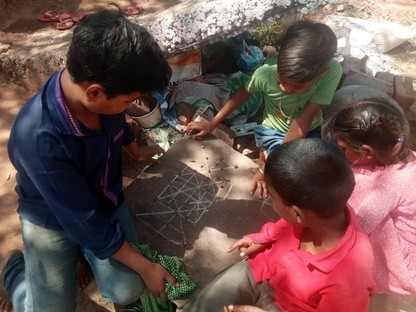
Children gather around for a game of Chaupar
The Chaupar board features a main playing area with two triangular extensions on both sides. It consists of 37 positions, where players place their pieces, known as gotis. Since this is a two-player game, each player starts with 16 pieces arranged as shown below.

Traditionally, players draw the board on the ground in home courtyards, community spaces called chaupals, or open areas in forests while grazing cattle or goats. They use natural materials such as stones, wooden pieces, seeds, or seashells as playing pieces.
Rules of the game
A. Game setup
A board is drawn on sand, stone, or any suitable surface.
Two players play against each other.
Each player starts with 16 pieces, totalling 32 pieces in the game.
Both players use pieces of different colours to differentiate their sets of pieces.
B. Moving the pieces
Players take turns moving their pieces one step in any direction: forwards, backwards, left, right, or diagonally.
Pieces move along the intersections drawn on the board.
C. Capturing or eliminating opponent’s pieces
Players capture their opponent’s pieces by jumping over them, similar to checkers.
If a player’s piece is next to an opponent’s piece with an empty space beyond it, they jump over and remove the opponent’s piece from the board.
Players can capture multiple pieces in a single move if the opportunity arises.
A player wins by either:
D. Special rules
Middle position on the sides of the board rule (Teekha niyam):
Triangle cut rule: When a player moves all their pieces out of the triangular area and declares a “triangle cut”, both players lose access to that area for the rest of the game.


