A struggle for water and dignity
Pardhi and Mogiya families in Gwalior organise for water access after years of exclusion, forcing public systems to recognise their rights.
A neighbourhood in Gwalior has existed for nearly two decades without a fundamental necessity: water. The Pardhi and Mogiya communities (historically, both have been nomadic, forest-dwelling hunters) have had settlements here since inception, yet no public arrangement for drinking or daily-use water had ever been made. Their exclusion was not accidental; it was enforced.
Adjacent to their settlement, live the Kanjar (historically, a semi-nomadic hunter-gatherer community who also weave baskets and work as folk entertainers and labourers) and Lohapita (historically, blacksmiths) communities, themselves marginalised groups. Hand pumps exist in their settlements. But Pardhi and Mogiya residents were barred from using them. When women or children tried to fetch water, their vessels were thrown away.
What emerges is an uncomfortable truth: communities that face discrimination are often forced into hierarchies where they, in turn, discriminate against those even further down the perceived social order. In this case, water became the instrument through which this control was exercised.
Denied access nearby, Pardhi and Mogiya families were compelled to walk nearly two kilometres to a highway-side dhaba to collect water. This daily task fell largely on women and children. Hours were lost each day, safety was compromised, and livelihoods suffered. Time that could have been spent working, studying, or resting was instead consumed by the sheer effort of survival.
Zenith began working with the communities in May 2023. At first, the problem appeared administratively simple. The ward councillor, when approached for a new hand pump, instructed neighbouring communities to “allow” access, a solution that collapsed immediately. When conflict followed, the councillor sided openly against the Pardhi and Mogiya residents who were accused of being quarrelsome.
What followed was a long, grinding engagement with the state. In August 2023, 40 residents, accompanied by the Zenith team, submitted representations to the Collector and Municipal Corporation. Despite assurances and surveys, nothing changed. Officials cited forest land restrictions, even though hand pumps already existed on similar land nearby. The truth surfaced slowly that infrastructure had been installed elsewhere not through rules, but through political interventions.
The struggle escalated with public hearings and repeated visits, finally reaching a minister. A directive was issued: if the basti lay on forest land, borewells would be installed at the boundary and water piped in. The community waited months despite being promised results in days.
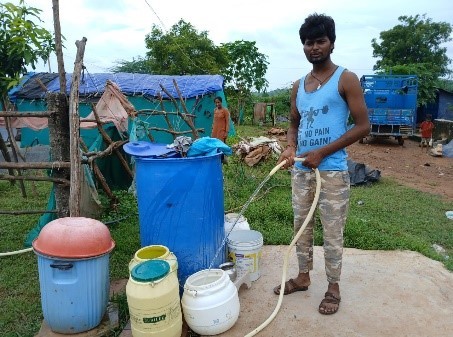
Collecting water: a daily chore.
Nearly a year later, borewells were drilled, pipelines laid, and household connections established. For the first time, water flowed freely into the settlement. The impact was immediate and profound. Children stopped walking to the highway and women reclaimed hours of their day. Work became possible, safety improved and dignity returned.
This was not just a victory over scarcity, but over exclusion. The struggle showed that collective action matters, persistence matters, and that even a slow, resistant state can be made to move. Most importantly, it proved that when communities fight together, they can force systems to recognise their right to exist and progress.


