SAMAVESH
Making public systems work for the public.
For a historically excluded and marginalised community like the Sahariya, state systems should be their strongest safeguard against injustice. But where do they go when the systems meant to protect them start shutting them out?


Sahariya Adivasis, a semi-nomadic tribe indigenous to dry deciduous forests of central India, have lived in these forests long before modern state boundaries were drawn.
Sahariya identity and culture has been built over many generations, but has primarily evolved from and been shaped by the forest ecosystem — from how homes are built to how incomes are sustained and resources are shared.


As these sources of survival are dismantled, Sahariyas become increasingly dependent on institutions outside the community. Land requires titles, food requires ration cards, education requires schools.
Yet accessing these systems requires documents, literacy, money, and specialised knowledge that generations of exclusion have placed beyond the means of the community.

Samavesh's mission is to help the Sahariya community turn their promised rights into lived realities, while helping public institutions listen, respond, and uphold those rights.
Help the community navigate public systems with dignity
By lowering barriers of documentation, complexity, cost, and opacity. Through pro-bono support, we help people file claims, access services, secure entitlements, and navigate administrative processes with confidence.
Help public systems respond to community needs
By making public systems more effective and reliable in responding to community needs. We do this by studying recurring failures, pressing for systemic reforms, and equipping institutions with the tools they need to serve communities better.
We believe
Good governance cannot be handed down to people. It must be built with them.
Teams on the ground.
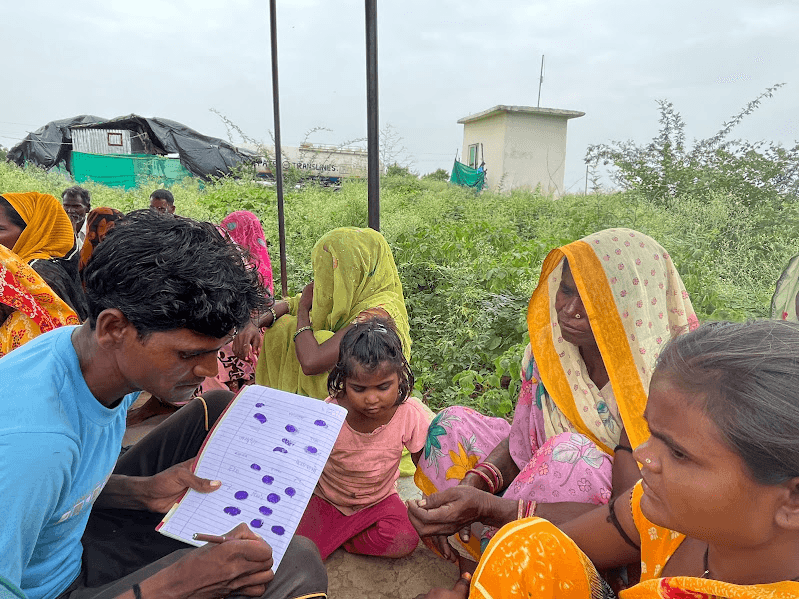
Our teams stand alongside Sahariyas wherever rights meet everyday life, helping turn distant institutions into systems people can understand, access, and rely on.
Forest rights
Helps Sahariyas secure individual and collective rights over forest land, resources, cultivation and habitation, including through forest-rights claims and stronger Gram Sabhas. This team also studies recurring violations and barriers to build community action and wider advocacy.

Land rights
Provides legal and administrative support to Sahariyas facing land disputes, missing records, bonded labour, violence, and other criminal justice concerns. This team also studies recurring cases to identify wider administrative barriers and systemic solutions.

Essential services
Helps Sahariyas access essential services such as ration, water, electricity, pensions, housing, healthcare, banking, credit, and insurance. It also studies recurring gaps in service delivery to identify wider administrative barriers and systemic solutions.
Act now
When a Sahariya faces injustice today, we cannot afford to simply wait for structural change. So when help is needed, we act immediately and directly.
Listen for patterns
A case may be urgent, but it is rarely isolated. We try to understand recurring patterns behind cases, where they come from, and why they continue to persist.
Make the case
We translate our learnings from the ground into rigorous research, public evidence and advocacy that make systemic failures visible and push institutions to address them.
Pave the way
To support lasting reform, we develop practical tools and resources that empower Sahariyas to assert their rights and institutions to respond and uphold them.
Stories of change


Invest in making systems accessible and rights usable.
Support us as we build a trusted local presence and pathways for community access and institutional effectiveness.