Ramlakhan: Adulthood and beyond
Ramlakhan Sahariya traces his path from labour and study to grassroots leadership, helping Adivasi families claim rights in Gokulpur.
The Sahariya Spotlight has been following Ramlakhan’s life journey over the past year, and this chapter brings us to the present and final part of his story published here. You can revisit the earlier segments here.
Our own home
Around 2017-2018, as Gwalior city expanded towards our village, the value of land in Gokulpur began to rise. The families living in our sahrana (settlement) started selling their land to people from other communities, lured by higher land prices. Gradually, all the families sold their land and moved to a new settlement elsewhere in the village. This created problems for our family, as our access routes were blocked, and we faced difficulties in daily movement. Eventually, we had no choice but to move to the new settlement. However, we did not sell our land.
In 2019, a house under the Pradhan Mantri Awas Yojana was sanctioned in my father’s name. This turned our dream of building a home into reality.
Seeking a stable future
Once I realised that good education was the only way to secure a government job, achieve financial stability, and support my family. I decided to continue my studies. In 2018, I completed a B.A. from MLB College, Gwalior. In 2022, I obtained a B.Ed. from SR College and in 2023, I enrolled in an M.A. programme at MLB College, which I am currently pursuing.
Around this time, I met Sunil Kumar from the Zenith Society in our Adivasi Basti of Gokulpur. He was gathering information about the Basti, such as the number of families living there, whether they were receiving government benefits, and if our documents were in order.
At first, I felt sceptical because many people had visited our settlement before, talked about our issues, made grand promises, and even collected money from us under the pretence of helping with document processing, only to disappear forever. I assumed Sunil Ji might do the same.
However, Sunil Ji kept visiting the settlement regularly, interacting with the residents. He began by helping the community obtain birth certificates for their children. Slowly, the community started to connect with him, and people began sharing their problems openly. My perspective also changed, and I realised that Zenith Society was genuinely working for our welfare, at the ground level.
Whenever Sunil Ji came to the Basti, he would visit my house to meet me, but I rarely got the chance to speak with him because of my household responsibilities, which required me to work as a labourer. Deep down, I always wanted to strengthen my community and work on its issues, but I couldn’t afford to leave my labour work. I never told Sunil Ji that despite being educated, I was compelled to work as a labourer. At that time, I earned INR 500 per day.
One day, Sunil Ji found out about my situation and asked,
“Why don’t you try for a job since you’re educated?”
I explained that I had tried many times but couldn’t secure one and that my family responsibilities forced me to continue as a labourer.
Sunil Ji promised to help me find employment and I secured a job at a local call centre. It was a desk job with security and comfort, but entailed longer hours than the labour work and paid 20% less too. Feeling underwhelmed, I decided to quit.
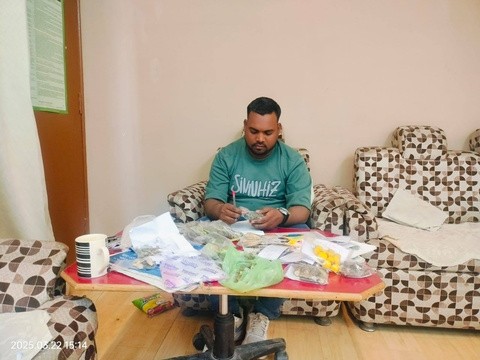
Ramlakhan preparing for a Sahariya Adivasi herbs and medicinal plants exhibit in a Zenith event
I shared my thoughts with Sunil Ji and expressed my desire to work with Zenith instead. The day I joined Zenith was incredibly special to me because I no longer needed to work as a labourer and could do something engaging and impactful using my education. I was given the chance to work with my community and contribute to meaningful change.
Currently, I assist tribal people in realising their constitutional rights, preparing documents, participating in public hearings, and addressing issues like land-related disputes. I take these cases to the tehsil office to help secure justice for them.
Whenever incidents of oppression or exploitation by other communities occur with Adivasis, I visit the affected families and guide them through the legal process with the help of Zenith’s team to ensure justice is served by organising them at the grassroots level.
Family life
There are 10 members in my family, and we live together as a joint family, caring for our dependant parents. They had an arranged marriage when my mother was 18 years old and my father was 21. I have an elder brother whose marriage was arranged at the age of 19. He now has three children.
I had an arranged marriage in May 2023. I knew my wife before marriage because our respective fathers are friends and our families frequently visited each other. My wife takes care of all the household chores. My life did not change significantly after marriage. But, ever since we had a child, I have become deeply attached to him. I want to provide my child with a good education so he can secure a government job. No one from my village's Adivasi Basti has ever secured a government job, and I would like my child to be the first.

Ramlakhan presenting at a training event organised by Azim Premji University
My family’s financial conditions
My brother and I are the two breadwinners earning between INR 12,000-15,000 each. In my view, an ideal monthly salary for me would be around INR 20,000. Over time we own a TV, two fans, a bike, and a loading taxi.
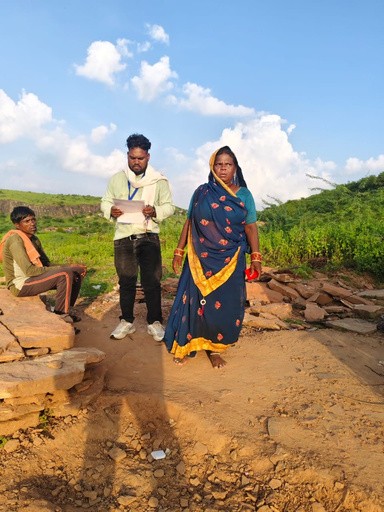
Ramlakhan checking documents at a field visit
The biggest financial concern for my family is the debt incurred from buying our vehicles. A fifth of our income goes towards grocery and a majority of the rest goes towards paying loan instalments for our vehicles. The repayment is especially important as my brother drives the loading vehicle for a living.
Our family benefits from some government schemes, including:
A house built under the Pradhan Mantri Awas Yojana.
Zero electricity bill.
A total of 65 kg of rice under the Public Distribution System.
My aspirations and options ahead
My foremost priority is to secure a government teaching job because it offers a good salary, job security, and pension benefits after retirement.
Frequently, I also consider pursuing a law degree and continue working with Zenith or independently serve my community. Politics also interests me as there is currently no one from my community in politics, nor is anyone highly educated to seek solutions to our issues.
Any of these choices would give me scope to focus on education for children and advocate for Adivasis’ rights or shape laws affecting us. Such social and economic progress will help us Sahariyas break free of our current constraints.


