Chaupar: The quiet strength of Sahariya board games
Sahariya board games turn simple materials into strategic play, carrying community memory, patience and skill across generations.
In the tranquil courtyards (called Chaupals) and sun-dappled clearings of the forest, members of the Sahariya community gather, not around a screen or a scoreboard, but around a game drawn into the earth itself.
Chaupar, one of their most beloved traditional games, is as lightweight in materials as it is rich in strategy. All it takes is a bit of space, a stick to draw the board, and whatever is at hand. Stones, seeds, shells, or wood become pieces in a battle of wits. Pawns or Gotis move along gridlines straight, sideways, diagonally and backwards to capture the opponent’s pieces and reach the other side of the board.

Often played during pastoral breaks, when elders and children rest while grazing goats or cattle, Chaupar transforms everyday moments into thoughtful play.
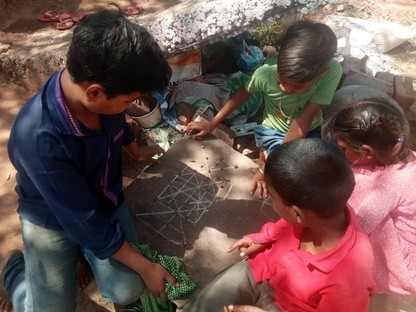
Children gather around for a game of Chaupar
At first glance, it may appear simple. You move your pieces across the board, capture your opponent’s, and block their path. But beneath the surface lies a world of tactics. Players must anticipate moves, control space, and master patience. Community elders say the game sharpens the mind and strengthens resolve. To them, it is not just play but holds life lessons.
Known by many names such as “16 Goti,” “16 Sipahi,” or “Chaupar,” this game endures even as mobile screens become more common.
The community also engages in Ashta Changa, a lively board game akin to Ludo, where four players take turns moving their pieces home, based on the roll of dice or cowrie shells. They also play Nakdua, another four-player strategy game involving 32 pieces, rich in tactics and tradition. Chava Cheat is another resource-light, playful coin game favoured by children. In Sahariya villages and forest paths, such games live on, carried in memory, drawn in dust, and played with joy.
Zenith’s team attempts to give you, our readers, a taste of Chaupar with the rules detailed in this post, where Ramlakhan Sahariya from Zenith teaches our team how to play this game.


